


In the wave of Industry 4.0 development, manufacturing is gradually moving toward intelligent, unmanned, and digital directions to enhance production efficiency and improve manufacturing standards. With technological advancements, non-standard customized equipment has become the main driver of production automation. For example, robotic arms used in material handling during processing assist human operations, reduce safety incidents, and mitigate risks. Robotic arms play an effective and direct role in industrial automated production. Generally speaking, the types of robotic arms vary depending on production requirements, including loading/unloading robotic arms, material handling robotic arms, welding robotic arms, and other material handling robotic arms.
As is well known, to drive mechanical equipment and achieve intelligent operations, a programmed control system is required to guide and implement these functions. This system is commonly referred to as the robotic arm control system, which acts as the “brain” directing equipment operations. It is achieved through programming and algorithms.
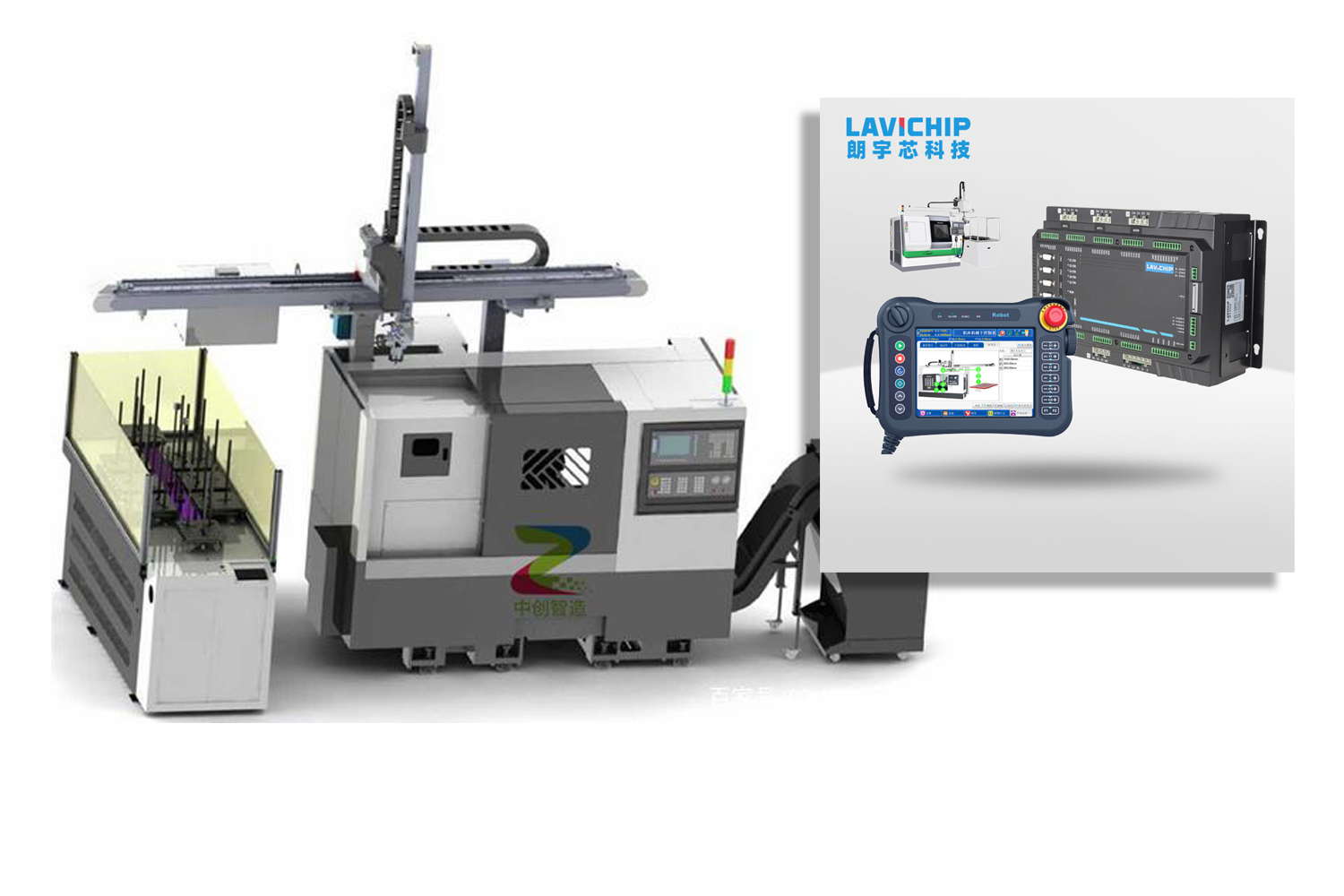
Regarding the general operational workflow of robotic arms, how can various rotational picking and placing operations be achieved through program algorithms? Automated loading and unloading robotic arms, through modular design, can be configured into any combination to form multi-machine automated production lines. The common main components include: X, Y, and Z axes, loading and unloading hoppers, grippers, and robotic arm control systems. Each module is mechanically independent and can be freely combined within a certain range to meet different functional requirements. They play a crucial role in manufacturing industries characterized by high repetition, high risk, and high production rates.
In machining processes, the robotic arm control system can drive two loading/unloading robotic arms—one for loading and one for unloading. Alternatively, a simpler approach uses two Z-axes to achieve the functionality of two robotic arms, with the same result.
What are the primary movements driven by the control system to operate the robotic arm? These are primarily manifested in the loading and unloading processes:
1. The process of automatically picking up raw material products and placing them onto fixtures using the control system:
Common raw materials are transported to designated positions via hoppers or chain conveyors. Pneumatic positioning mechanisms are used to align the raw materials, ensuring consistent gripping positions for the robotic arms. Common actions include: when the X-axis moves to the front of the raw material, the Z-axis moves downward and opens the grippers, Closes the jaws upon reaching the designated position, then moves the Z-axis upward to the desired position, followed by the X-axis moving to place the raw material into the fixture. The fixture then clamps the workpiece, the jaws release and move upward, repeating this cycle.
2. The control system directs the material handling robot to remove the workpiece from the fixture and place it at the designated position:
First, the loading/unloading manipulator moves above the fixture, then the Z-axis moves downward to securely grip the workpiece with the clamps, while releasing the fixture. Upon receiving the signal that the clamps have released the workpiece, the Z-axis moves upward to remove the workpiece, followed by the X-axis placing the workpiece at the designated position and lowering the Z-axis, thereby completing the automatic unloading process of the manipulator.
The advantages of using a robotic arm control system lie in its ability to ensure automated processes during mechanical equipment manufacturing, enabling fully automated, unmanned operations. This enhances the primary processing efficiency of enterprises. Under high-precision operations, it also guarantees production efficiency, reducing the time efficiency of a production process on a production line to as low as five seconds, thereby lowering operational costs.
Stability and reliability are its key advantages. A well-designed control system with safety features must not only deliver precision but also reliability, minimizing faults and ensuring safe operation by replacing manual labor.